Skip to content

Marina Tropmann-Frick

Towards Responsibility Evaluation of Generative Language Models

An evaluation of the responsibility of generative AI models presents unique challenges that require holistic and practical solutions. This paper introduces an enhanced version of the VERIFAI framework, which extends beyond classification models to assess generative language models as well… Read More »Towards Responsibility Evaluation of Generative Language Models
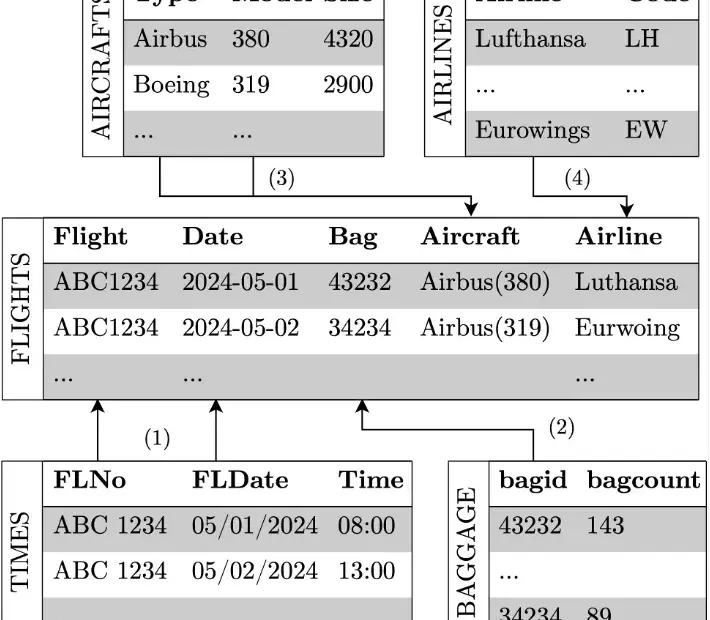
Automating Data Fusion: Techniques for Handling of Join Scenarios

In real-world data integration scenarios, traditional equi-joins and other join techniques have huge difficulties due to heterogenity and inconsistencies in attribute values. To address this challenge, we present AutoStarJoin, a technique for automated joins specifically designed for star-join scenarios. The core… Read More »Automating Data Fusion: Techniques for Handling of Join Scenarios

LLMs for Easy Language Translation: A Case Study on German Public Authorities Web Pages

This paper examines the use of Large Language Models (LLMs) for the intralingual translation of documents from standard German to German Easy Language (Leichte Sprache). We use open-weight models, from the Llama 3 family, with less than ten billion parameters.… Read More »LLMs for Easy Language Translation: A Case Study on German Public Authorities Web Pages

Automatisierte prädiktive Analytik in der Gepäckabfertigung

Ziel dieser Arbeit ist die Entwicklung und Validierung eines automatisierten Prognosemodells für Gepäckmengen am Hamburger Flughafen unter Verwendung der Low-Code AutoML-Bibliothek PyCaret. Durch die Automatisierung signifikanter Phasen des Machine-Learning-Lebenszyklus konnten präzise Vorhersagen für Gepäckstücke pro Flug innerhalb und außerhalb der… Read More »Automatisierte prädiktive Analytik in der Gepäckabfertigung

Responsible Artificial Intelligence: A Structured Literature Review

Our research endeavors to advance the concept of responsible artificial intelligence (AI), a topic of increasing importance within EU policy discussions. The EU has recently issued several publications emphasizing the necessity of trust in AI, underscoring the dual nature of… Read More »Responsible Artificial Intelligence: A Structured Literature Review

Bridging the Gap between Theory and Practice: Towards Responsible AI Evaluation

The growing integration of artificial intelligence (AI) in diverse sectors underscores the need for comprehensive and standardized approaches to ensure AI responsibility. However, the absence of a holistic framework to evaluate the fairness, privacy-preserving, secure, explainable, and human-centered facets of… Read More »Bridging the Gap between Theory and Practice: Towards Responsible AI Evaluation

VERIFAI – A Step Towards Evaluating the Responsibility of AI-Systems

This work represents the first step towards a unified framework for evaluating an AI system’s responsibility by building a prototype application.The python based web-application uses several libraries for testing the fairness, robustness, privacy, and explainability of a machine-learning model as… Read More »VERIFAI – A Step Towards Evaluating the Responsibility of AI-Systems

Scalp the Foreign Exchange Market with Deep Reinforcement Learning

This paper presents a reinforcement learning approach for foreign exchange trading. Inspired by technical analysis methods, this approach makes use of technical indicators by encoding them into Gramian Angular Fields and searches for patterns that indicate price movements using convolutional… Read More »Scalp the Foreign Exchange Market with Deep Reinforcement Learning

XAI in the Audit Domain – Explaining an Autoencoder Model for Anomaly Detection

Detecting erroneous or fraudulent business transactions and corre-sponding journal entries imposes a significant challenge for auditors during annualaudits. One possible solution to cope with these problems is the use of machinelearning methods, such as an autoencoder, to identify unusual journal… Read More »XAI in the Audit Domain – Explaining an Autoencoder Model for Anomaly Detection